Tree Removal vs. Tree Trimming: Which Do You Actually Need?
2026-09-01
Most of the calls we get start the same way: "I think I need this tree taken down." Maybe a quarter of the time, we get out there and the honest answer is no, you need about two hours of trimming and you're done. The other direction happens too, where someone asks for a trim on a tree that has already lost the argument and should come out before hurricane season peaks.
It's September, which is the worst month to still be undecided. So here's how we actually make the call, and what each job costs in real terms.
The line between the two jobs
Trimming fixes a problem in the branches. Removal fixes a problem in the trunk or the roots.
That one sentence sorts most trees. A live oak with a huge limb hanging over your roof in Carrollwood, a laurel oak with dead wood in the canopy, a sabal palm with a skirt of dead fronds and seed pods — those are branch problems. You cut what's wrong, the tree keeps standing, and you're paying for a fraction of what a removal costs.
But when the defect is structural, pruning is expensive decoration. The things that put a tree on the removal list:
- Decay at the base or in the trunk. Shelf fungus at the root flare, a hollow that swallows your arm, a soft spot you can push a screwdriver into. A canopy trim does nothing for a compromised trunk.
- A failing root plate. A new lean, soil heaving on the opposite side, roots lifting a sidewalk or driveway. We saw a lot of that through Helene and Milton, and it almost never announced itself the day of the storm — the tilt was there for months first.
- More than about half the canopy dead. A tree that's already lost that much isn't coming back in Florida heat. It's a standing pile of future projectiles.
- The tree is simply in the wrong place. A water oak eight feet off the foundation, a queen palm under the service drop. No amount of pruning fixes geometry.
That's the only checklist in this article, because the rest of it is judgment, not a list.
What the photo shows
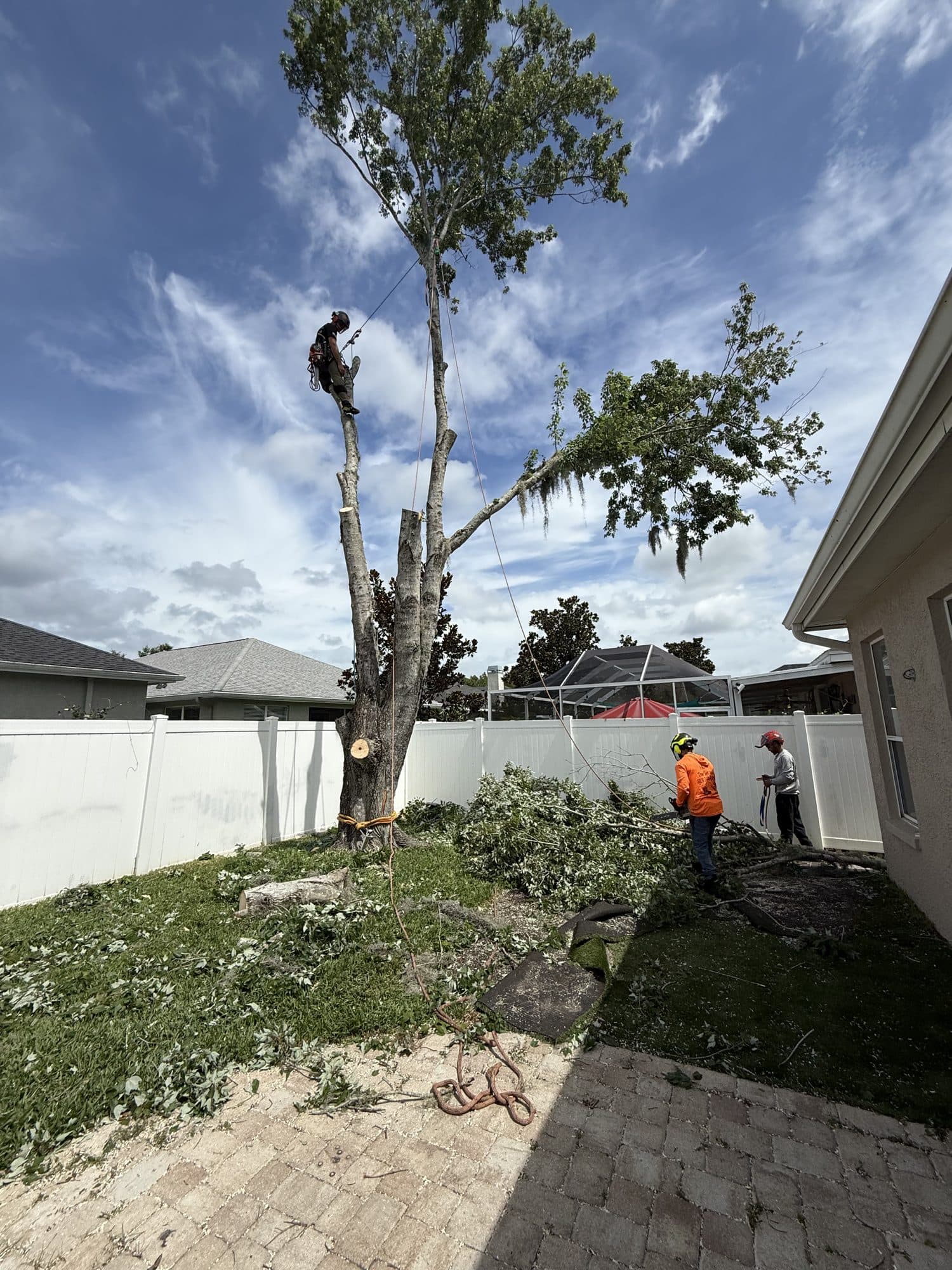
The picture at the top is one of our climbers mid-rig, roped in and taking a tree down piece by piece rather than dropping it. That's what removal actually looks like on most Tampa Bay lots, and it explains the price difference better than any pricing chart. When a tree stands over a pool cage, a fence line, a neighbor's roof or a screen enclosure — which describes nearly every yard in Northdale, Cheval and Westchase — nobody gets to fell it in one motion. Somebody climbs it or goes up in the bucket, cuts it in sections, and rigs each piece down on ropes so it lands where we choose. Every one of those pieces is a separate decision. That labor is the cost.
A trim is the same climber, the same gear, but he's up there for a couple of hours making cuts and coming back down. The tree stays. There's no rigging plan, no stump, and a fraction of the debris to haul.
What each actually costs
We won't put a single number on your tree from a blog post, and you should be skeptical of any company that does. But the shape of it is consistent:
Trimming is priced by canopy size, height and access. Palms are the cheapest work we do, especially several in a row on the same visit. A mid-size oak that a climber can work comfortably is a routine half-day job. A 70-foot live oak spreading over a house and a pool cage takes a full crew, a bucket truck and a lot of rope, and it prices accordingly.
Removal runs meaningfully higher than trimming the same tree, and the multiplier depends less on the tree than on what's underneath it. Wide open backyard in Lutz or Thonotosassa where we can drop it and haul it out with the grapple truck? That's the cheap end. Same tree over a screen enclosure with a six-foot side gate as the only access? That's the expensive end, and the difference between the two isn't small.
Two things people forget to ask about. First, the stump is usually quoted separately — removal means the tree is gone, not that the ground is level. Second, debris. A big oak generates a startling volume of wood, and hauling it is real work; ask whether the quote includes it or you'll find out later.
Get everything in writing, itemized, from anybody you call. We put ours in writing every time.
When we tell people not to remove a tree
A healthy live oak is worth keeping. It's shading your roof and cutting your July electric bill, it holds soil, and you cannot buy a replacement — you can plant one, but not one that size, not in your lifetime. If a tree's only sin is that it's big and it worries you, the fix is usually thinning and weight reduction, done well, so wind moves through it instead of pushing on it.
Where we push the other way is on trees that have already told us how they're going to fail. Deadwood in the canopy, a cracked limb union, fungus at the base. Removing that tree in September costs a normal price. Removing it in October off your roof, with a tarp and an insurance adjuster involved, does not.
Get a straight answer on your tree
We'll come look, tell you which one it is, and put an exact price in writing. Free, in person, anywhere we serve — Lutz, Tampa, Carrollwood, Wesley Chapel, Land O' Lakes, Odessa, Keystone and the rest of Tampa Bay. Plenty of those visits end with us telling you to save your money.
Call (813) 751-5732 for an estimate, or (813) 244-0050 for removals and storm work, answered 24/7.