Hurricane Season 2026: How to Get Your Tampa Bay Trees Ready
2026-07-10
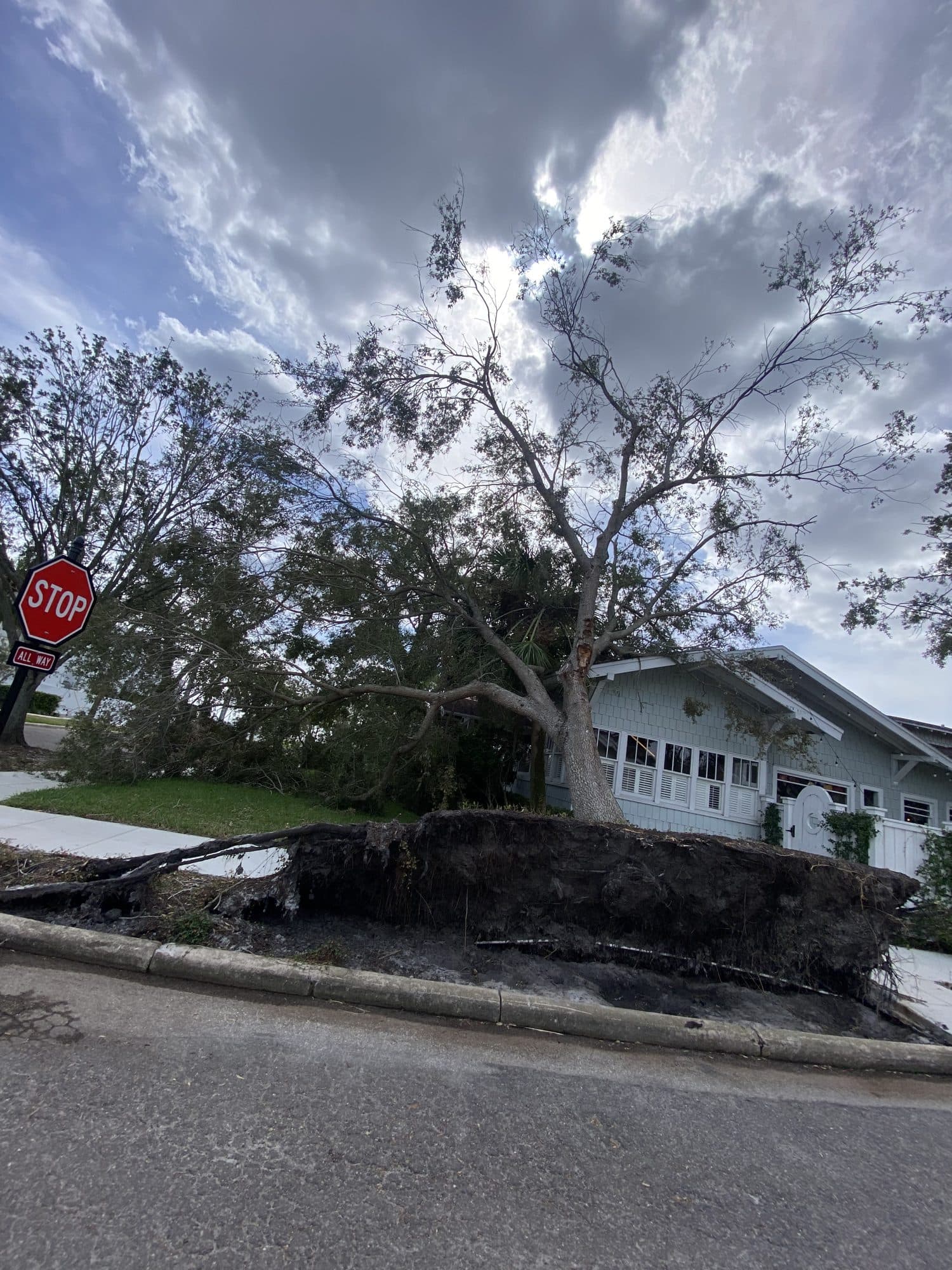
Hurricane season runs June through November, and if you live in Tampa Bay you already know the calendar's real shape: the Gulf gets serious in August, September is the month that makes the news, and whatever you were "meaning to do" about the trees needs to be done before that. This is the checklist we run on our own properties in Lutz — written in July on purpose, because July is when there's still time to act on it.
We worked through Helene and Milton back to back. The photo above is what an oak does when a storm finds the weakness first — the root plate lifts, and the tree, the sidewalk and sometimes the service line go together. Almost every tree we removed off a house in those weeks had shown a warning sign beforehand. That's the whole argument for this article.
The July walk-around: five things to look for
Take ten minutes and walk your yard like we would. You're looking for:
A new or increasing lean. Trees that have always leaned and grown that way can be fine. A lean that wasn't there last year — especially with soil lifting or roots exposed on the opposite side — means the root plate is failing. That tree is choosing between falling in a storm or falling on a calm day, and storms usually win.
Dead wood you can see. Bare limbs in a green canopy, big dead branches hanging ("widow-makers"), bark falling off in sheets. Deadwood is the first thing a tropical-storm gust removes, and it doesn't ask where it lands.
Mushrooms or shelf fungus at the base. Fungus fruiting on the trunk or root flare usually means decay inside, where you can't see it. A tree can look full and green and be hollow at the base — we cut them open every season and the neighbors are always surprised.
Cracks where big limbs meet the trunk. Especially on laurel oaks and water oaks, which grow fast, age fast, and split exactly there. If you can see a seam or a dark stain running down from a limb union, get it looked at.
What's over the roof, the driveway, and the power drop. Not every overhanging limb is a hazard — but every limb that would hit something if it failed deserves a decision, not a shrug. The driveway question matters more than people think: after a storm, a blocked driveway is the difference between getting to work and waiting three days for a crew.
Any one of these is worth a professional opinion. Ours is free, in person, anywhere in our Tampa Bay service area — and "that tree is fine, save your money" is an answer we give constantly.
What actually protects a tree in wind
The goal of pre-season trimming isn't to make a tree smaller — it's to let wind pass through the canopy instead of pushing against it like a sail:
- Thinning removes selected interior growth so gusts blow through.
- Deadwooding takes out the guaranteed projectiles.
- Weight reduction shortens and lightens over-extended limbs — the ones reaching over your roof — so they carry less leverage in a gust.
- Clearance pruning gets limbs off the roofline and away from the power drop to your house.
What it's not: "hurricane cuts," topping, or gutting a tree down to stubs — that butchery creates future storm damage by forcing weak, fast regrowth. And palms don't need to be stripped bald: over-trimmed "rooster tail" palms are actually weaker in wind than a full, healthy crown. Dead fronds and seed pods off, green fronds stay.
The order of operations, if you're prioritizing
Budget or time limited? Do it in this order:
- Remove standing dead trees. They're not a maybe — a dead pine or oak will drop in serious wind, guaranteed. They're also cheaper to remove standing than off your roof.
- Deal with the leaner and the fungus tree (the failing-root cases). These are the ones that end up in the news photos.
- Weight-reduce whatever hangs over the house, the cars, the pool cage.
- Thin the big healthy canopies so the wind treats them kindly.
- Clear the driveway line so that whatever happens, you can leave.
Do it now, not in August
Every tree company in Tampa Bay gets slammed at exactly two moments: the week a named storm appears on the forecast map, and the month after it hits. In the pre-storm rush, quality work gets scarce and prices reflect panic. In July, crews have room in the schedule, quotes are calm and considered, and the trimming has time to matter. The best storm work we do all year happens weeks before anyone can pronounce the storm's name.
If a storm does catch you with a tree down: stay away from anything touching a power line, photograph everything for insurance before cleanup, keep everyone out of rooms under a tree on the roof — and call (813) 244-0050, which we answer 24/7. We wrote more about that in Why You Should Never Delay Tree Removal After a Storm.
The free version of peace of mind
An H&M pre-season inspection costs nothing: we walk the property with you, tell you which trees genuinely need work and which don't, and put exact prices in writing. Some of the best visits end with "everything's fine, see you after the season." The worst outcome in this business is the call we get in September about the tree we could have fixed in July.
Request your free storm-readiness estimate or call (813) 751-5732 — we cover Tampa, Lutz, Land O' Lakes, Wesley Chapel, Odessa, Keystone, New Tampa, South Tampa and the surrounding Tampa Bay area.
H&M Tree Service is a family-owned, fully insured tree care company serving Lutz, Tampa, and the greater Tampa Bay area — offering tree removal, trimming, stump grinding, land clearing, grapple truck services, and 24/7 emergency response.