How Many Tree Service Quotes Should You Get Before Hiring?
2026-07-01
Short answer: three is the sweet spot for most jobs — but the right number depends on the size of the job, how urgent it is, and how confident you are that a company is being straight with you. Below, we’ll break down when three is enough, when one is fine, and when you should keep dialing.
If you’ve ever stood in your yard staring up at a leaning oak wondering who to call, you already know the hard part isn’t finding a tree service. It’s figuring out whether the price you’re being quoted is fair, safe, and complete. Getting multiple quotes is how you answer that — but more isn’t always better, and fewer isn’t always risky.
At H&M Tree Service, we’ve given thousands of estimates across Lutz, Tampa, and the greater Tampa Bay area. We’ve also lost bids to lowball competitors and later cleaned up the damage when those jobs went sideways. So this isn’t theory. Here’s how we’d coach a friend or family member to think about it.
The quick answer, by job type
| Situation | Quotes we’d get |
|---|---|
| Routine trimming or a small removal | 2–3 |
| Large removal, multiple trees, or work near your house/power lines | 3, sometimes 4 |
| True emergency (storm damage, tree on your roof) | 1 — safety and speed win |
| You already have a trusted arborist | 1 is fine |
Why three is the magic number for most jobs
Three quotes gives you something one or two can’t: a range. One quote tells you a price. Two quotes tell you which is cheaper. Three quotes tell you what the job actually costs — because you start to see the market cluster.
When you get three estimates and two land around $1,800 and one comes in at $900, that $900 quote isn’t a deal. It’s a warning. It usually means one of a few things: they’re not insured, they’re not accounting for cleanup and haul-away, they’re planning to leave the stump, or they underbid to win the job and will find “surprises” once they start.
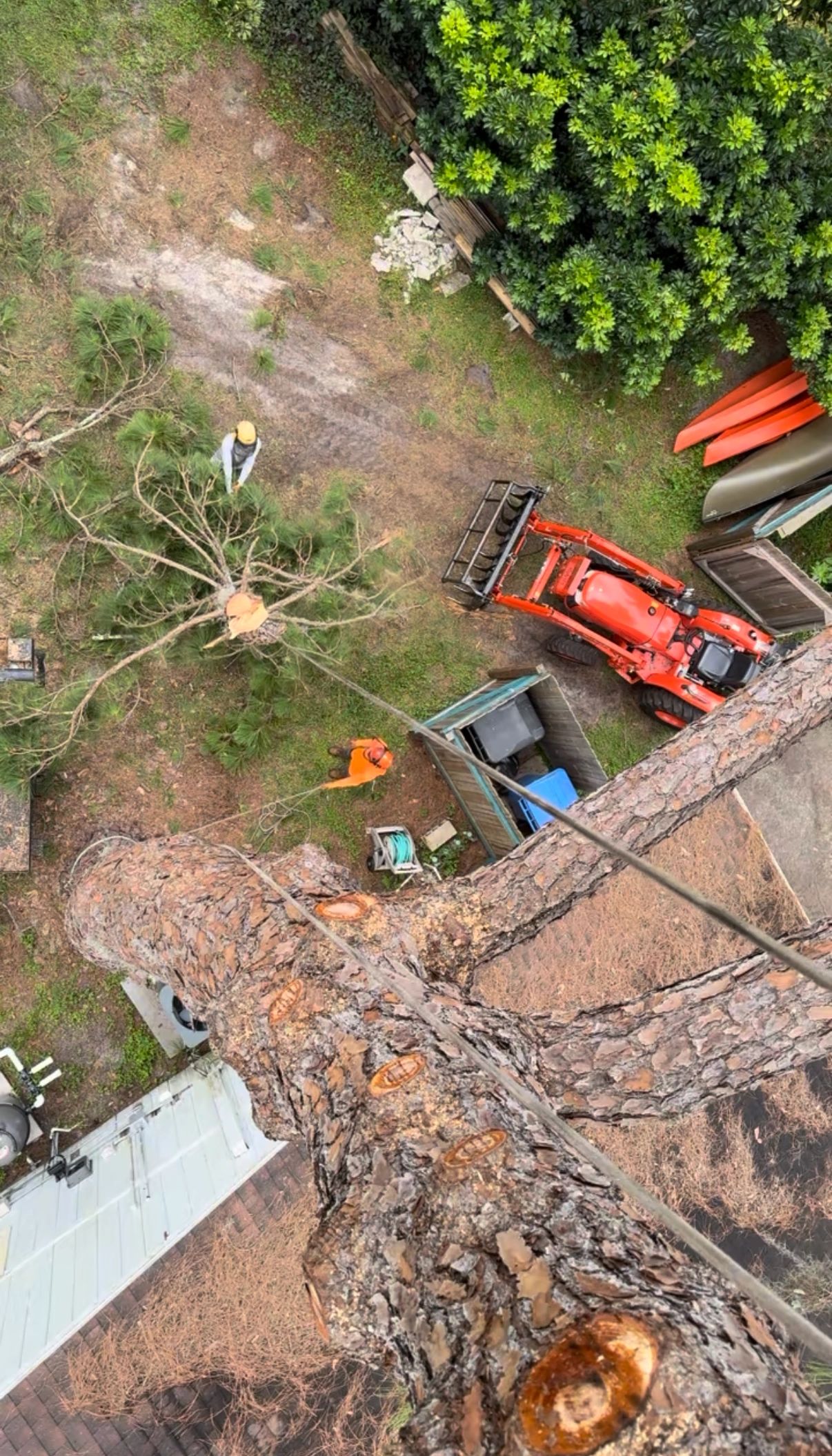
We see this play out several times a season, especially after storms. A homeowner gets three quotes on a big laurel oak leaning toward the house. Two of us land in the $2,200–$2,600 range, and a guy with a pickup and a chainsaw says $1,100. The low number wins — right up until his crew realizes they can’t safely rope the limbs away from the roofline. Now there’s a gouge in the fascia, brush left across the yard, and the stump still standing because grinding “wasn’t part of the price.” The homeowner ends up calling a company like ours to finish the job, and pays twice. The lesson isn’t that cheap is always bad. It’s that a price with no plan behind it isn’t really a quote — it’s a guess you end up paying for.
Three also protects you from the opposite problem: the padded quote. Some companies price high hoping you won’t shop around. A third data point keeps everyone honest.
When you don’t need three quotes
Emergencies. If a tree is on your house, blocking your driveway, or hanging over where your kids play, do not spend two days collecting estimates. Call a licensed, insured company that can respond now. Our 24/7 emergency crews exist precisely because storm damage in Tampa Bay doesn’t wait for a bidding process. Speed and safety are the priority; you can dispute price later, but you can’t undo a limb through your roof.
Small, straightforward jobs. A single small tree or a routine trim from a company you’ve used before? One quote is plenty. The cost of your time chasing three estimates outweighs the few dollars you might save.
When you already have a relationship. If a certified arborist has walked your property, knows your trees, and has earned your trust, loyalty is worth something. Good tree companies remember repeat customers and take extra care with them.
Here’s my honest opinion, even though it might cost me a bid now and then: shop the first job hard. Get your three quotes, ask your questions, and find a company that shows up on time, does clean work, and treats your property like their own. But once you’ve found that company — stop shopping. The few dollars you might squeeze out of re-bidding a routine trim every year are tiny, and a crew that already knows your trees, your gate code, and where your irrigation lines run will do safer, better work than a stranger underbidding to win you over. Loyalty gets earned on the first job and repaid on every one after.
The mistake almost everyone makes: comparing price instead of scope
Here’s the part most blog posts skip. Two quotes for “tree removal” can be wildly different jobs. Before you compare a single dollar figure, make sure each quote spells out:
Is the stump included, or ground separately? Stump grinding is often a separate line item. A cheaper quote may simply be leaving you a stump.
Is cleanup and haul-away included? Some crews cut, drop, and leave. Hauling debris is real labor and real dump fees.
How close is the drop zone to your house, fence, or power lines? Technical removals near structures cost more for good reason — they require rigging, not just felling.
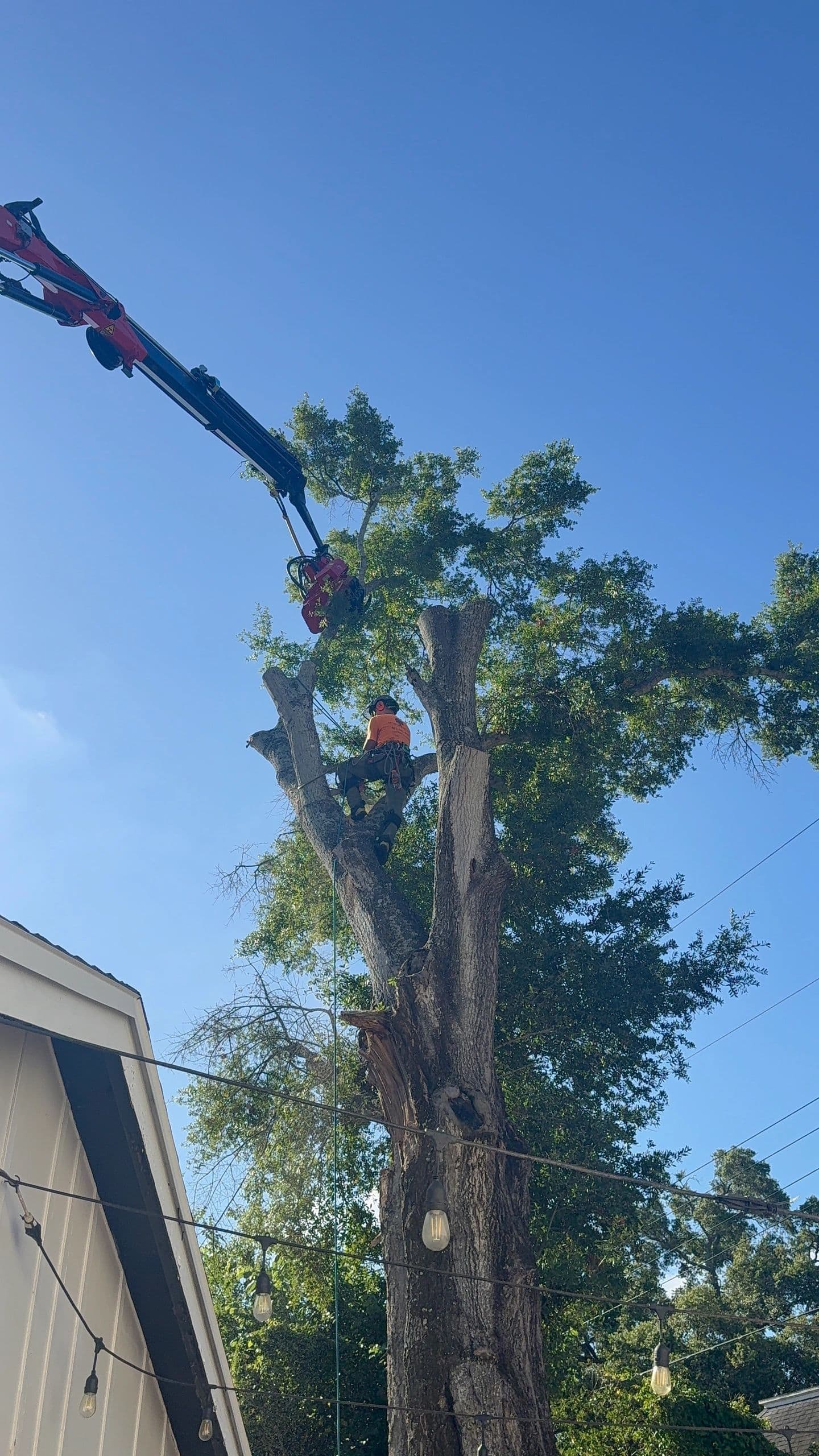
Are they using the right equipment? A grapple truck job is faster and lower-impact on your lawn than a crew dragging brush by hand. That can be worth paying for.
Insurance and workers’ comp. This is non-negotiable. If an uninsured worker is hurt on your property, you can be liable.
When every quote is scoped the same way, you’re finally comparing apples to apples — and the “expensive” quote often turns out to be the complete one.
Here’s the kind of job that shows exactly why scope beats sticker price — and it’s one we run into constantly around Tampa Bay. Picture a large live oak, the beautiful wide-canopy kind you see all over this area, that’s grown out over both a screened lanai and the power drop feeding the house. Simple on paper, dangerous in practice: you can’t just fell those limbs. Every major branch has to be roped, cut in sections, and lowered by hand so nothing touches the screen enclosure or the line to the house.
A complete quote on a removal like that runs in the neighborhood of $3,400 — and that number includes rigging the limbs down safely, a grapple truck to haul everything out without rutting up the lawn, and grinding the stump below grade. A stripped-down competitor quote might read $1,900, but that number quietly assumes felling from the ground and lists haul-away and the stump as separate add-ons. Add those back in and the “cheaper” quote lands within a couple hundred dollars of the complete one — minus the rigging safety, minus the grapple truck, minus the peace of mind.
The homeowner who chooses the complete quote gets the oak down clean, the lanai untouched, and the power still on. That’s the whole point: the honest quote isn’t the one that looks cheapest on the first read — it’s the one that told the truth about the work from the start.
Red flags that mean “get another quote” — no matter the number
Regardless of how many estimates you’ve gathered, keep shopping if you see any of these:
No proof of insurance, or hesitation when you ask for it.
Door-knockers after a storm demanding cash up front. Reputable companies don’t work this way.
A quote scribbled on a business card with no breakdown of scope.
No certified arborist on staff for anything involving the health of a tree you want to keep.
Pressure to decide “right now” for a non-emergency job.
If I could get one warning in front of every homeowner in Tampa Bay, it’s this:
Never pay cash up front to someone who knocked on your door after a storm.
The reputable crews are already booked solving real emergencies — they’re not cruising neighborhoods looking for a quick payday. Anyone demanding money before the work starts, with no written scope and no proof of insurance, is the single biggest red flag in this trade. A real company will give you a breakdown, show you their coverage, and let the work earn the payment.
What actually makes a quote worth trusting
A number on a page is only as good as the company behind it. When you’re weighing your two or three estimates, the tiebreaker usually isn’t price — it’s:
Whether a certified arborist actually looked at the tree.
Whether the company is family-owned and local, with a reputation in the community they can’t afford to burn.
Whether they walked your property, explained the plan, and answered questions without rushing you.
That’s the standard we hold ourselves to at H&M, and it’s the standard we’d tell you to hold anyone to.
The bottom line
For most homeowners, get three quotes — enough to see the real market price and spot the outliers. Drop to one when it’s an emergency, a small job, or a company you already trust. And whatever number you land on, compare scope, not just price: a complete quote at a fair price beats a cheap quote that leaves you with a stump, a mess, and a liability.
If you’re anywhere in the Tampa Bay area and want an honest, no-pressure estimate to put up against the others, that’s exactly what we’re here for.
H&M Tree Service is a family-owned, fully insured tree care company serving Lutz, Tampa, and the greater Tampa Bay area — offering tree removal, trimming, stump grinding, land clearing, grapple truck services, and 24/7 emergency response.